

The crypto market is facing one of its most turbulent stretches of 2026. Bitcoin has shed more than 13% over the past week, Ethereum is testing multi-month lows, and billions of dollars in leveraged positions have been forcibly closed.
Here are the five biggest developments driving the cryptocurrency market today.
1. Bitcoin plunges below $64K as $1.5 billion get liquidated
Bitcoin tumbled to an intraday low of approximately $61,300 before recovering to the $62,500–$64,000 range on Thursday, its weakest level since late February.
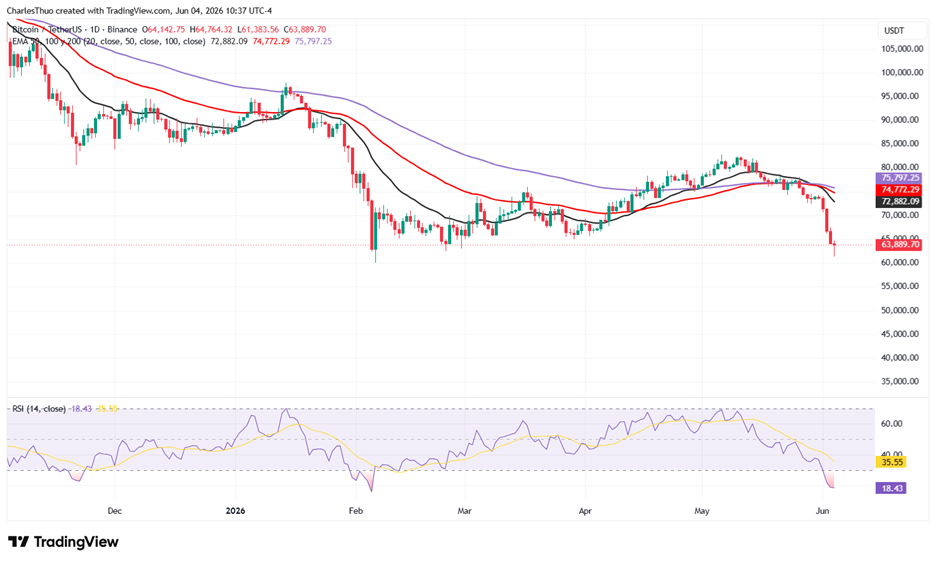
The slide triggered roughly $1.5 billion in crypto liquidations in a single 24-hour period, with long positions absorbing the bulk of the damage.
Over the past two days, cumulative liquidations across the market climbed toward $3 billion as cascading sell orders amplified the downside move.
The technical picture is firmly bearish. Bitcoin is trading below its 20, 50, and 100-day moving averages, and its weekly RSI has fallen into the low 20s, deeply oversold territory.
Analysts are now watching the $60,000 level, which aligns closely with the 200-week moving average and has historically served as a long-term support floor. A confirmed break below that level could expose BTC to a move toward the $55,000 region.
2. US spot Bitcoin ETFs log a record 20-day outflow streak
The most consequential institutional story of the week, and arguably the month, is the unrelenting exodus from US spot Bitcoin ETFs.
As of June 4, these funds have recorded 20 consecutive days of net outflows, the longest withdrawal streak since the products launched in January 2024.
According to Coinglass data, cumulative outflows over recent weeks have surpassed $4 billion, pulling total ETF assets under management down from a peak of approximately $104 billion to around $83 billion.
The selling pressure has been broad-based. BlackRock’s iShares Bitcoin Trust (IBIT) recorded one of its largest single-day redemptions in late May at $528 million, narrowly missing its all-time daily outflow record. Fidelity and Grayscale products also saw significant withdrawals.
The proximate causes include rising US Treasury yields following a hawkish shift in Federal Reserve language, hotter-than-expected inflation data (headline CPI came in at 3.8%), and a notable rotation of institutional capital toward AI and semiconductor stocks, with Nvidia gaining roughly 6% in the same period.
3. Strategy breaks its “Never Sell” pledge, and the crypto market notices
In a development carrying outsized symbolic weight, Michael Saylor’s Strategy (Nasdaq: MSTR) disclosed in a June 1 SEC filing that it sold 32 Bitcoin between May 26 and May 31 at an average price of $77,135 per coin, raising approximately $2.5 million to fund dividends on its preferred stock. It was the company’s first net Bitcoin sale since December 2022.
On paper, the transaction is almost trivially small; 32 BTC represents just 0.0038% of Strategy’s 843,706-coin balance sheet. But the market treated the announcement as a five-alarm signal, sending Bitcoin down more than 3% within hours and erasing an estimated $160 billion in total crypto market value over the following sessions.
Saylor had spent years publicly advocating for a “never sell” philosophy, and the company’s consistent accumulation had become a cornerstone of the institutional Bitcoin narrative.
Analyst reaction was split. TD Cowen’s Lance Vitanza called the transaction “economically immaterial” and argued it did not change the core accumulation thesis.
Others pointed to it as evidence that the era of unconditional corporate Bitcoin buying may be maturing, particularly as dozens of treasury firms that replicated Strategy’s playbook have since halted purchases or begun unwinding positions amid the prolonged price decline.
4. Solana hits its longest losing streak in history as altcoins bleed out
Bitcoin is not suffering alone. Solana closed eight consecutive red monthly candles through May 2026, the longest monthly losing streak in the token’s history, and was trading near $73 on June 4 after shedding more than 12% in just one week. The token has lost roughly $78 billion in market capitalization since its October 2025 peak.
Ethereum fell from $1,810 at Thursday’s open to around $1,740 by mid-morning, down more than 45% year-to-date. XRP, meanwhile, slipped from $1.34 to around $1.23 during the broader June sell-off.
Derivatives markets are also flashing warning signs: put option skews have strengthened on both Bitcoin and Ether, and the $60,000 strike put on the Deribit options exchange carries over $1 billion in notional open interest, a sign that institutional traders are actively hedging for further downside.
The one counterpoint for Solana bulls is that the network’s on-chain fundamentals remain resilient. Mastercard selected Solana as one of eight blockchains to support regulated stablecoin settlement, and the network processed over $832 billion in stablecoin transfer volume during Q1 2026.
The Alpenglow protocol upgrade, which targets sub-150 millisecond transaction finality, is also progressing on testnet, and Solana spot ETFs have accumulated over $1 billion in cumulative inflows since their launch.
5. The CLARITY Act faces legislative hurdles as stablecoin yield debate intensifies
In the regulatory arena, the US CLARITY Act, the comprehensive digital asset market structure bill, continues to face significant headwinds as it works its way through the Senate.
The legislation, which would grant the CFTC exclusive jurisdiction over digital commodity spot markets while preserving SEC oversight for investment contracts, has stalled primarily over a single contentious issue: stablecoin yield.
Banks are pushing hard for provisions that would prohibit crypto firms from offering interest on stablecoins, arguing that such products compete unfairly with federally regulated deposit accounts.
The crypto industry, led by Coinbase CEO Brian Armstrong, is pushing back, arguing that stablecoin yield represents revenue sharing from Treasury bill interest rather than a deposit product.
For Coinbase, stablecoin-related revenue accounted for close to 20% of total revenue in Q3 2025, making the stakes existential for some business models.
JPMorgan analysts, who had projected the bill could pass by mid-2026, now note that disputes over yield-bearing stablecoins and DeFi treatment remain unresolved.
The next major milestone is a Senate floor vote, which may not materialize before the August congressional recess, potentially pushing broader crypto regulatory reform into late 2026 or beyond.
The bottom line
The June 2026 crypto market is caught in a confluence of macro headwinds: sticky inflation, a hawkish Federal Reserve, a capital rotation into AI equities, institutional ETF redemptions, and fragile sentiment following Strategy’s symbolic Bitcoin sale.
The $60,000 level on Bitcoin is now the line that traders and analysts alike are watching most closely. A hold there could attract bargain buyers; a convincing break lower could deepen the correction considerably.
Regulatory clarity remains a double-edged sword. Passage of the CLARITY Act could serve as a major catalyst for the second half of 2026, but its delay extends the uncertainty that has kept many institutional allocators on the sidelines.
About The Author